Monday, July 5, 2010

Flag football is king for day at Rooney's residence in Dublin

Pittsburgh Post-Gazette
Monday, July 05, 2010

DUBLIN, Ireland -- American flags flapped in the wind, blue smoke swirled from barbeques, and Dan Rooney, owner of the Pittsburgh Steelers, presided over a game of American football.

It could have been a Fourth of July event in the United States. But this was Dublin, Ireland, where Mr. Rooney is the U.S. ambassador, and he was making history by staging an "Irish American Flag Football Classic" at his residence in the capital city's Phoenix Park.

Mr. Rooney brought 32 members of his extended family to Dublin for the occasion, including his sons Art Rooney II, team president of the Pittsburgh Steelers, and Dan, the Steelers' college scout. The pair were given two days to select and train opposing teams of Irish and American volunteers, the "Dublin 8s" and the "Phoenix Park Pirates," for a challenge game as the centerpiece of an old-fashioned July 4th picnic.

Ireland's Prime Minister Brian Cowen took a break from watching World Cup games on television and was given the honor of tossing the coin.

The team rosters included embassy diplomats and Marines, local Gaelic football, rugby and soccer players, and the neighbor's kids -- Ireland's President Mary McAleese lives in a nearby wooded estate and her son, Justin, kitted out in yellow for the Dublin 8s, and daughter, Emma, played in blue for the Pirates.

The idea of a first-ever American football game at the residence arose after Mr. Rooney presented his credentials to President McAleese on July 3rd last year. He discovered next day that the U.S. embassy staged an Independence Day baseball game on the 62-acre property.

"I thought, hey, if you can do a baseball game, you can have a football game," Mr. Rooney said.

The decision to replace baseball with football involved lengthy preparation. It took two months to prepare a football field on the vast meadow in front of the elegant 230-year-old residence, which before Irish independence belonged to Britain's chief secretary in Ireland. The task was undertaken by Peter McKenna, stadium director of Dublin's Croke Park.

"The ambassador asked could we make a pitch," said Mr. McKenna, making a last-minute inspection as hundreds of Irish and American guests gathered on the sidelines. "There was a lot of undulating ground and we had to lift the grass and fill in the holes to create a flat surface."

He provided bleachers, American football posts (made in Belfast) and giant television screens for live coverage and play-backs. He had the word "Steelers" painted on the thick-blade meadow grass and the ambassador's seal of office in the middle.

Mr. McKenna constructed the pitch pro bono as a way of saying thank you to American team owners, including Mr. Rooney, who had provided advice for the reconstruction six years ago of the stands at Croke Park, the home of Gaelic football, which now has a capacity of 82,000.

"The Croke Park people did a marvelous job," said Mr. Rooney at the start of the event, which was sponsored by the American Chamber of Commerce and Pepsico.

Mr. Rooney, credited with the "Rooney Rule" that which requires NFL teams to interview minority candidates for management and coaching vacancies, developed his own set of "Rooney Rules" for this game. For example, he had ruled that it should be a noncontact game of flag football, played with only eight on each side as the ground was somewhat smaller than regulation size.

Historic trees on the fringes could not be moved to make it bigger. These included a northern red oak planted by Vice President George H.W. Bush on a visit in 1983 and a giant spruce put there in 1868 by the Prince of Wales.

The one thing the ambassador could not guarantee was the cooperation of the notoriously fickle Irish summer weather.

"We walked around the pitch saying the rosary every evening and praying for sunshine," the ambassador's wife, Patricia, said. The Rooneys are practicing Catholics, and the ambassador attends Mass every day, wherever his duties take him.

After a morning of rain, the clouds rolled away and the game was played in blazing sunshine. Mr. Cowen and most everyone else took off their jackets, munched on hot dogs, scooped up ice cream and watched the Dublin 8s hammer the Pirates, 28-15.

Over the loudspeakers commentator Paul Collins from Ireland's Today FM radio station teased Art Rooney unmercifully, suggesting he don sunglasses to disguise himself on the seven-hour flight home.

After the game, Mr. Rooney said he has invited President Barack Obama to visit Ireland.

"I have been urging him to come," said Mr. Rooney. "We have installed a new basketball hoop ready for him."

Problems at home such as the oil spill in the Gulf of Mexico have kept him from traveling abroad, said Mr. Rooney. "But he wants to come," he added.

Archie Roberts comes full circle in the NFL

Los Angeles Times
by Jerry Crowe
July 4, 2010

After playing only one game as a professional in the 1960s, Roberts focused on a career as a surgeon. He now has partnered with the NFL Players Assn. to screen retired players for heart disease.

Reporting from New York — Archie Roberts knew he faced daunting, almost impossibly long odds, but he was young, ambitious and maybe a little naive.

He wanted to be a surgeon and a professional football player.

So there he was in the mid-1960s, the Columbia graduate and aspiring quarterback endeavoring to make an impression on the Cleveland Browns and Miami Dolphins while also attending medical school, a daunting double few would even attempt.

Roberts, his professional football experience limited to one game, ultimately left a more indelible legacy with a scalpel than a football, performing more than 4,000 open-heart procedures during 2½ decades as a cardiovascular surgeon.

More recently, he founded the Living Heart Foundation, which pioneered advanced mobile methods for cardiovascular screening in an attempt to raise awareness about heart disease.

Concerned about the increasing size of NFL players and the risks associated with the added weight, Roberts has partnered with the NFL Players Assn. to screen retired players.

"It's really something wonderful," Andre Collins, a former NFL linebacker and director of the NFLPA's retired players division, says of the program. "There have been life-threatening situations that have been avoided because of these routine screenings."

Roberts, 67, estimates that about 1,500 former players have been tested so far, with about 10,000 more to go.

"It feels natural and comfortable," the physician passer says of his return to the NFL universe all these years later. "I can make a contribution where I feel there has been a real need."

A three-sport letterman as a prep star in Holyoke, Mass., and again at Columbia, Roberts decided before he ever set foot on the Ivy League campus in Manhattan's Morningside Heights neighborhood that he would pursue a career in medicine.

But his football and baseball success at Columbia, where he set numerous Ivy League records in football and was an All-American shortstop, gave him opportunities he never anticipated.

The Kansas City Athletics, he says, wanted to make him a high pick in the 1965 amateur baseball draft — but only if the undergraduate would leave school a semester early.

The New York Jets showed interest too, making him the 51st pick in the 1965 AFL draft — after making Joe Namath the first.

"It was tempting," Roberts says over coffee during a late-morning interview at a midtown Manhattan eatery. "The money in sports back then wasn't what it is now, but to a kid that had very little money, from a small town in western Massachusetts, any kind of money like they were talking about, whether it was football or baseball, would have been appreciated.

"But it was not meant to be for me because of the way I was brought up and the value systems I had developed."

Medicine was his mission.

But then the Browns made an offer he couldn't refuse: In a deal brokered by owner Art Modell, a transplanted New Yorker, they paid for Roberts to study medicine at Case Western Reserve University while basically working part-time for the Browns.

For two seasons, Roberts joined the Browns at training camp, stayed with them through the exhibition season and then was assigned to the taxi squad as an emergency backup.

"In today's age, it wouldn't be possible," he says of the arrangement, "but even in those days, it was way out."

Roberts, however, longed to do more than sit and watch.

In 1967, sensing a greater opportunity elsewhere and without objection from the Browns, he signed with the Dolphins, who had joined the AFL as an expansion team a year earlier.

"But as luck would have it," Roberts says, laughing, " Bob Griese was drafted and came in that year."

During a semester's leave of absence from medical school, however, Roberts finally got onto the field.

In a 41-0 loss to the Kansas City Chiefs, he completed five of 10 passes for 11 yards, with one interception.

And that was that.

He never played again and, after the season, returned to med school to resume his studies. A few years later, Roberts launched a distinguished career as a cardiologist.

Settled in Little Silver, N.J., with wife Nancy, the grandfather of six looked forward to several more years of open-heart procedures when, in 1997, he felt numbness in his right arm and helplessly slurred his words while giving a lecture.

He had suffered a stroke.

"I was a doctor giving advice to my patients but not living healthy myself," says the 6-foot, 190-pound Roberts, who at the time carried an additional 25 pounds. "There were risk factors that any good doctor would have recognized — I had put on weight and my cholesterol was high — yet I was too busy doing my thing.

"And that's pretty stupid."

The stroke may have prematurely ended Roberts' surgical career, but it led him back to the NFL through his foundation.

What if, years ago, he'd devoted his full attention to football?

"I've often wondered," Roberts says. "I'll always wonder. But I can never answer the question."

Thousands of heart patients, of course, are the better for it.

Sunday, July 4, 2010

"I was never diagnosed with a concussion"

Chicago Sun-Times
July 2, 2010
BY RICK TELANDER Sun-Times Columnist

I can hear Jack Rudnay swearing, and it alarms me. The yelling is not loud, nor is it constant. But it has an edge to it. ''[Bleep]er!'' I wait a moment, and there is quiet. I'm sitting on a chair in the guest bedroom at Rudnay's farm 160 miles southeast of Kansas City, Mo., near the tiny town of Versailles. There are just the two of us here, other than his six horses, the pet turtle in the tank and the multitudinous largemouth bass in his 18-acre lake.

Jack is divorced and his two daughters are grown. He drives to Kansas City several times a week to run his veterinary supply manufacturing business and to spend time with his girlfriend, Linda. But he is alone often here on the farm, in these wooded hills with the grassy fields and the half-mile-long gravel driveway that, as he puts it, ''Nobody drives down by mistake.''

I hear him again. ''[Bleep]!''

I walk out of the bedroom and look into the large, glassed, high-ceiling room that holds the one-lane swimming pool that is now as much a part of Rudnay's world as breathing.

He is on his back in the center of the pool, in baggy black trunks, his body lean and pale, dogpaddling fitfully against the constant current. Rudnay's eyes are closed, his breathing labored, his jaw set in defiance.

''[Bleep]er!'' he hisses.

I back out quietly. A few minutes later, when he has dried off and re-entered the main house, I ask Rudnay how his swim was.

''Good,'' he says. ''Very good.''

Jack Rudnay, 62, is a battered man. He will never complain. Never. That's not how you become one of the greatest linemen in Northwestern history and a 13-year NFL veteran -- all of them with the Kansas City Chiefs -- four of those years as the AFC starting center in the Pro Bowl.

You've probably seen Rudnay in that oft-run Silver Bullet beer commercial, the one with Chiefs coach Hank Stram prancing on the Super Bowl IV sideline. Rudnay's the bearded guy in the business suit behind Stram. Jack fractured three vertebrae in the 1969 College All-Star Game, and was on injured reserve for that 1970 Super Bowl championship, his rookie year.

The back injury was just the start; or rather, it was a continuation of the thread of wounds and rehabilitation and denial that was already being stitched into the fabric of his being. A working-class kid from Chagrin Falls, Ohio, outside Cleveland, Rudnay wrestled in the state high school tourney with two separated shoulders, and never had or expected toys as a child. Recruited mostly by Ivy League schools, he arrived at Northwestern in the late summer of 1965, driven by a high school pal in a rusting Pontiac Tempest. The pal dropped Rudnay off outside Elder Hall on Sheridan Road, turned around and drove back to Cleveland.

''There were happy families everywhere,'' recalls Rudnay, whose own father died when Jack was 2. ''I had three cardboard boxes, and I'm standing there alone. It was like a foreign country.''

When he tells a story such as this -- simply and succinctly -- there is such passion welded into his words that Rudnay often will get teary-eyed and his voice will crack. Sometimes the tears literally stream down his face, such as when he described the joy of being asked two years ago by Northwestern coach Pat Fitzgerald to address the Wildcats football team on the field. ''It was beautiful for me,'' he said. We were in his car when he told me that story, on the long drive from the Kansas City Airport, and at first I thought he might have allergies or dust in his eyes. Eventually, he wiped the tears from his face and we drove on.

But Rudnay never weeps over physical pain. He has a specially built hot tub on the deck next to his pool, with high-pressure jets that are customized for his wrists, hips and back. And the 19-foot constant-current pool is the gentlest way he can exercise. Indeed, it's basically the only way.

On bad days, Jack is halfway crippled, overwhelmed by nerve pain in his arms and spine and throbbing osteoarthritis pain in just about every other joint. One knee is sort of OK, but that is compromised by the four surgeries to replace a damaged right hip joint.

The first surgery wasn't a success, and the hip kept slipping out of its socket. Ten times that happened. Rudnay learned how to get the dislocated joint back in place by using rope or sheets, wrapping them around his foot and having several people hold his torso while one yanked the coil as hard as possible.

Dr. Victoria Brander, an associate professor of physical medicine and rehabilitation at Northwestern University and a partner in the Northwestern Orthopedic Institute, says she marvels at the former football players she sees in her arthritis practice.

''Matched to their non-athlete peers, the level of arthritis for them is much greater,'' she says. ''Yet their perception of pain and disability is much less. These old warriors. They refuse to give in.'' She sighs, looking at me suspiciously. ''As if it's giving in.''

Pat Harrington, the captain of our Northwestern team in 1969, and an arthritically challenged hobbler himself, calls Rudnay's farmhouse set-up ''Aqua Land.'' A better term might be ''Water World,'' for without the H2O and the pain pills and the nerve pills he takes when he starts to get mean and intolerant, Rudnay would live in something closer to hell.

''I never was diagnosed with a concussion,'' he says. ''But I went into the Green Bay huddle a couple of times.''

The warrior code meant Rudnay continued on, out of duty. Indeed, he played in 144 straight NFL games after 30 straight with Northwestern. ''I felt it was a sacred obligation with my teammates and my opponents,'' he says, sounding philosophical. He reads constantly and he meditates, and he says, ''I think I'm a Buddhist, spiritually, at least. I'm alone a lot, and the universe is my church.''

But he also practiced in the church of hurt, becoming a high priest there. At Northwestern, he was a 6-3, 235-pound dynamo at defensive tackle and center, and though he got up to 280 pounds in the NFL, he would often drop to as low as 220 by the end of the season. It was his battery that never faltered.

''I wanted the ability to have an on-off switch, and believe me, you didn't want to see me on Sunday,'' he says. ''I was a professional killer.''

During the weekend that I am with Rudnay, he gets a call from former lineman Ed White, a friend of his who played 17 years with the Minnesota Vikings and San Diego Chargers. It is interesting, because what they discuss is the passing of a beloved assistant coach and a ''brain study'' in California they would like to be involved in because there is word that some of the herbal additives and powders being talked about can restore or enhance mental capacity.

Like all of us around 60, Rudnay isn't sure what his brain should be like.

''I guess my short-term memory has been slightly affected [by head blows],'' he says. ''But how do you know? I always forgot things.''

He had looked at me as we slowly walked toward his lake in the morning.

''You got a hitch in your giddy-up there, brother,'' he said, concerned.

Yes, I'm joint-damaged like the others, though a lot of it is from pick-up basketball, if it matters. My right shoulder has never been good since a tackle junior year. Some of my fingers are messed up. We all chose to do what we did, anyway. How many concussions did I have in football? One? Two? What's the joke answer: None, that I remember! And a firestorm last winter in my spinal cord staggers me yet. Transverse myelitis they call it. From a flu shot? From football? Both arms and one leg were paralyzed. Scary as hell.

Rudnay quotes Carlos Castaneda to me, ''We either make ourselves miserable, or we make ourselves happy. The amount of work is the same.''

Rudnay's the guy who has dislocated every finger on both hands and dislocated both big toes so badly that they touched the top of each foot. Sometimes he has to turn on the ignition of his car with his left hand because the right hand won't work. His blocking technique was to punch with both hands after centering the ball -- ''maybe a million times,'' he says. This destroyed his wrists. And once he busted the little finger on his right hand so badly that the bone protruded from the skin. He taped the pinky to his ring finger.

''The team doctor said, 'You are through.' I said, 'Doc, you don't understand. I'm kicking this guy's ass!'''

He went back in, and blood from his pinky spattered the white pants of startled quarterback Mike Livingston and tailback Ed Podolak on each snap.

So it goes.

''People get pain and suffering confused,'' Rudnay says.

We do.

"I have to jot things down to remember them"

July 4, 2010

George Keporos was a specimen. The curly haired tackle stood 6-1, weighed 255 pounds, had 21-inch arms, a 22-inch neck, benched 350, and ran the 40 in 4.9. This was 40 years ago, before such things were common. Still, George sometimes got knocked around, as everyone who played Big Ten football did. In the 1971 Northwestern opener against Michigan at Dyche Stadium, he took a blow to the head and went down.

''I got knocked out before half, and they carried me off the field,'' he says now, as we sit in the living room of his compact but luxurious condo on Illinois Street. just east of Michigan Avenue. ''We were ahead, 6-0, when I went out, and I wake up on the bench and it's 21-6, Michigan!

He laughs at the silliness of the tale, the cartoon-like dreaminess that comes with getting the old bell rung. But George played hard and got dinged a few times. And some of the players around him were concerned.

When Eric Hutchinson, our All-America free safety, got a concussion in a 1970 game, he came to the sideline and was disoriented and done for the day. Tears trickled down his cheeks as he watched the game. ''Please don't make me like George,'' he pleaded to no one.

We all joked about each other's head collisions, about seeing stars, about birds tweeting, planets circling. Hutchinson was briefly out of his mind and had no idea what he was saying for that day. Brain trauma was not that big a deal back in that era, anyway, largely because no one understood the lingering or delayed or compounding effects of such unseen wounds.

It also was hard to take any injury seriously when the guy looked fine. That is rapidly changing. A recent Time Magazine cover story on the dangers of football states, ''No other sport gives rise to as many serious brain injuries as football. High school players alone suffer 43,000 to 67,000 concussions per year, though the true incidence is likely much higher.'' The reason the incidence is underreported is that most concussed players never say anything about their symptoms.

There is another, unwitting, culprit here. In a survey, college trainers stated that they observed concussions in only about 6 percent of the players under their watch. But when the college players were asked anonymously, more than 70 percent said they had experienced concussion-like symptoms. Clearly, it's hard for trainers to diagnose what they don't know much about and the wounded won't describe.

George Keporos, 60, looks good, feels good, and he's in good health. He's a big dude, but he has run in 14 marathons. His joints are fine. He's happy, has three beautiful daughters, ages 21 to 28, and because he's recently divorced, he is dating again.

But none of us know about our heads.

After Northwestern, Keporos had a free-agent tryout with the Bears, and then he got into the car business with his father. George proved to be an outstanding salesman and businessman. He and his dad built up their stores until they had successful Lincoln-Mercury, Honda, Ford and Accura dealerships in Chicago. When they sold out at the perfect time -- 2007 -- George walked away with millions.

But what does the future hold? We all know the horror stories about former NFL players like Andre Waters, who shot himself at 44, and was found to have brain tissue resembling that of an 85-year-old man, with characteristics of early stage Alzheimer's.

But that's the NFL. Waters was a banger for a dozen years after college. Chronic traumatic encephalopathy (CTE) is a long term for what boxers call dementia pugilistica, or plain old punch drunk. Yet it doesn't matter if you get the blows from a glove or a helmet, or, for that matter, fastballs or hockey checks. CTE can apparently strike anyone who has had repeated and violent brain trauma.

Our middle linebacker John Voorhees likes to talk about the punch drunk boxer who used to loiter in front of the Busy Bee hamburger joint in downtown Peoria, near where John went to high school. The boxer was harmless, but he talked crazy stuff to the Spaulding guys when they came by for hot dogs, and he just seemed like a funny aberration.

I talked to Freddie Roach in Los Angeles recently. He's superstar boxer Manny Pacquiao's trainer, and he has trained 25 world champions. But he was once a ferocious pro fighter himself. Though he was only 49 when we talked, Roach staggered about because of Parkinson's syndrome caused by boxing too long. His first symptoms appeared at age 27.

''They told me to retire, and I had five more fights and got knocked out in two of them,'' he says. ''I probably have dementia -- pugilistica dementia. I do respond to Dopamine two times a day. But I have tremors, I have drop-foot, I trip a lot.''

It's hard to get out on top, isn't it? I say to him.

He smiles ruefully. ''Only one of my fighters retired as a champion.''

But such stories might be irrelevant to us former college football players. We didn't play for years and years. We didn't exclusively hit each other in the heads.

Talk about good brains? There were 31 players on our freshman team in 1967, and 18 made it to our senior season. Among the 18, we have three post-graduate education degrees, a doctorate of veterinary science, four MBAs, three law degrees and two Ph.Ds. (I'm sorry for bringing the curve down with my lowly B.A.)

By almost any measure, George Keporos, in the class behind me that has two MDs among its ranks, has been a success in life. While we were talking, his youngest daughter, Kelly, a 6-1 recently graduated scholarship volleyball player at Northwestern, entered the apartment, dropped off a few things, hugged her pop, said, ''I love you,'' and left. Their affection was obvious. George's life is good.

But we're talking about maybes here. Kelly, after all, has two bad knees, and George says she'll likely need replacement surgery in her 30s. Sports competition carries its toll. I ask George if he has had any brain issues.

''My memory isn't what it used to be,'' he says. ''I have to jot things down to remember them. I leave things on the counter over there and forget to pick them up. My memory loss is getting worse. Is that because I'm getting old?''

I laugh. I looked for my reading glasses for five minutes the other day, and they were on my head. I put the orange-juice in the cereal cabinet. I'm no judge.

George and I look at an old photo of him sacking the Syracuse quarterback. We study the enlarged and framed newspaper page with photos of the Illinois 1967 All-State High School football team, with George there as well as Peoria's Voorhees, Elmhurst's Jack Derning and Moline's Randy Anderson, all of whom would be terrific players for Northwestern.

''You know, five years ago, I had amnesia,'' George says. ''From 9 to 5 of that day I have no memory.''

I look at him. I think about this. ''Then how do you know it happened?''

''I'd gone to work and the manager at the store said I was walking in circles,'' he says. ''He asked me if I was OK, and I kept saying, 'I don't know.' He drove me to the hospital, and at the hospital they asked me who the president was and I didn't know. I couldn't remember anything in the present. There's a name for what I had. But they couldn't find any reason for it, and it went away that day. I'm thinking, 'How about that hit in college?'''

A half hour after I leave, George calls my cell phone.

''I remembered it,'' he says. ''It's called transient global amnesia.''

Transient global amnesia, or TGA, has been described by neurologist Oliver Sacks as temporary ''amnesia for the amnesia,'' in that for a brief time one can't remember that one has no memory. It's unknown what causes it, but stress, migraines, head injuries, compromised blood flow to the brain, sudden immersion in cold water, even sexual intercourse are believed to be possible catalysts.

It strikes me in a silly way that during the time when George was trying to recall the name of the episode, he displayed amnesia to the third level. Not true. As the Mayo Clinic describes it, TGA ''is rare, seemingly harmless and unlikely to happen again. Episodes are usually short-lived, and afterward your memory is fine.''

George is fine. As we all are for now. Until, as Sacks puts it, the ''final amnesia'' comes calling.

Mike Adamle won't let anything stop him

June 27, 2010
by Rick Telander
Chicago Sun-Times

'I was on the air in 1999 when I had my first seizure,'' says Mike Adamle, the Channel 5 sportscaster. I ask him what it felt like. ''One part of my brain was speaking, the other part was having a tidal wave,'' he says. ''There was deja vu. All kinds of flashing, loud ringing in my ears. Dizziness. My short-term memory was gone. There were tears in my eyes, thoughts of being a kid, thoughts of my grandfather. I was in the hospital for three days.''

Mike and I go way back, to the late summer of 1967, when we greeted each other for the first time on the sidewalk in front of Anderson Hall at Northwestern University. We were incoming freshman scholarship football players, and we were to college life as shrimp eggs are to the sea.

In this series, Rick Telander catches up with former teammates, who describe how football helped them in their lives, but also how injuries suffered 40 years ago haunt them today.

I was 18, almost 6-2, a mighty 188 pounds, with a crew cut and barely a beard. He was 17, maybe 5-9, wearing shorts, seemingly muscle-free, baby-faced with a big smile. My first thought upon looking at him was, ''This team is in trouble.'' I knew Cub Scouts who looked older than Adamle.

He was from Kent, Ohio, played linebacker and running back, and I knew immediately that my suspicions about Northwestern football were correct: The program only took plankton from the bottom of the aquarium after it had been drained and the plastic mermaid removed. That plainly was the case with myself -- an unwanted, weak-armed quarterback from Peoria, projected, like all suspect high school quarterbacks, to be a defensive back in college.

But this infant was to be our running back? I am not kidding when I say that, at that moment, a protective shield whirred down over my delicate self-esteem and I steeled myself for four years of having my ass handed to me on a platter.

Fast-forward to the fall of 1970, our senior season, when Adamle would lead the Wildcats to within 30 minutes of going undefeated in the Big Ten, our only conference defeat coming against Ohio State in Columbus after leading at the half. There was the Wisconsin game that season when Adamle carried the ball for a Big Ten-record 316 yards. There was the Silver Football Award he would win as the best offensive player in the Big Ten. He was our captain and our leader.

''I have epilepsy from lesions on the left hemisphere of my brain,'' he says now, tapping the upper left part of his head. ''Scar tissue up there. From football. Neurologist Richard Rovenor, from Northwestern Memorial, diagnosed it and probably saved my life. I went to his funeral recently, and I shoveled dirt on his casket. He was a guy who knew about football, a wonderful man. He helped me so much, and I miss him.''

What do you do for the epilepsy? I ask.

''I take medications,'' he said. ''And when they stop working, I take different ones.''

What if you feel a seizure coming on?

''I try to get in a safe place, tell people to help me so I don't bite or swallow my tongue, and I get in the fetal position,'' he says.

I ponder this. I am amazed, astounded. It's one thing to have epilepsy; it's another to have it and be on TV, to do everything Mike does.

''I looked at the tape of that first time,'' he says, ''and I don't think people knew. I have lost words on air occasionally, and viewers have sent letters to the news director, wondering if I'm drunk. Maybe some people feel sorry for me, but I want people to know about this.''

We look at each other. Why not? The clock is ticking for us all.

• •

The toughest, smartest and most talented people I played with at NU were defensive tackle Jack Rudnay, safety Eric Hutchinson, linebacker John Voorhees and Adamle. Adamle was the best.

He looked like a child back then -- though he's 60 now, he still looks 10 or more years younger than I do -- but he weighed a deceptive 198 pounds and could leg-press 680 pounds. One man couldn't tackle him. His thighs were massive (which I hadn't noticed), his balance uncanny. And his desire was off the charts.

In that record-setting Wisconsin game in Madison, our coach, Alex Agase, called Adamle's number eight consecutive times on one scoring drive. Not just his number, the same play. By the end, even the body-passing student drunks in Camp Randall knew Adamle was going off right tackle. When he scored on the last of the runs, he looked fresh. But he wasn't.

''I had bite marks, scratches all over me,'' he says.

And then there were the head blows. We all took them. But when you carry the ball 483 times in three seasons -- 48 times in one game (Minnesota, senior year) -- you up the ante dramatically.

''Saw stars?'' Adamle says. ''I can't count the times.''

We're eating dinner at P.J. Clarke's on Fairbanks, not far from the NBC studio. Adamle is off today, no newscast, and he's having a yolk-free spinach omelet and a glass of red wine. He's in terrific shape, having recently completed the Ironman in Hawaii -- a 2.4-mile swim, 112-mile bike ride and 26.2-mile run -- in a better time than he did at 50.

He's always up for physical challenges, always has been. He has jumped from airplanes, scuba-dived, gotten in the ring with a pro wrestler, run up the John Hancock Center stairs. At Northwestern, he ate 50 hard-boiled eggs in an hour, just like our hero, Cool Hand Luke.

I saw Mike one day at the 2000 Olympics in Sydney, Australia -- he was there doing TV work -- and the area around one eye was a hideous pastiche of green and purple. He'd done a back flip off the 10-meter board and landed on his face. He'd never tried such a dive before, never been on a 10-meter board. But he'd told his boss at NBC, Larry Wert, a former varsity diver at Wisconsin, that he had to do it.

''He'd come into my office, and we'd practice,'' Wert says. ''He'd fall backward, and I'd catch him. I told him, 'Stand there. Look out. Fall. Don't move your head.' Then I said, 'Do you really want to do this?'''

He did.

Wert remembers how it ended.

''I got a call from a worker in Sydney, who said, 'Your boy splattered,''' Wert says.

The irony is that Wert, never a football player, did a lot of head and spine trauma to himself in his seemingly gentler sport. He hit his head twice on diving platforms, suffering two concussions and multiple stitches. Entering the water again and again at almost 40 mph eventually led to him having to undergo cervical fusion because of ruined vertebrae. He has to medicate himself because of the constant neck pain, and he says there are days ''when I'm speaking to a crowd or to our team, and I wonder if I'm up to it, feeling ready.''

But he wouldn't give up his athletic past for anything.

''Not a chance,'' Wert almost shouts. ''Competing brought me everything.''

So he understands the drive of the hyper-competitive Adamle, saying: ''I'm aware of his condition, and I'm supportive of him. There's always risk in live television for all performers. If things happen, we'll discuss them.''

• •

In a victory against Illinois in our junior year, Adamle got knocked out at the end of a long run. He played seven seasons in the NFL, once gaining 100 yards for the Bears. While with the New York Jets, he was on the ''suicide'' bomb squad with fellow wild man Lou Piccone, an undersized speedster who sometimes wore a ''Saturday Night Live'' conehead off the field. Together, they were wedge-busters.

''Lou was R-1 and I was L-1,'' Adamle says. ''Before games, we painted red suns on our chests, drank sake and yelled, 'Banzai!' One time we agreed to dive over the wedge simultaneously. We launched ourselves and landed on the receiver. Our quarterback, Joe Namath, said it was the best freaking play he'd ever seen.''

When did the brain trauma occur for Adamle? Who can say? Maybe it happened in increments. Maybe it happened as I and other Northwestern defensive players watched from the sidelines, cheering him on.

On a recent broadcast on Channel 5, Adamle does a fine job reporting the day's sports news, finishing a bland non- statement from Bulls general manager Gar Forman with the editorialism, ''Blah, blah-blah, blah-blah, blah-BLAH!'' It's appropriate and hilarious.

''Mike is a bona fide celebrity athlete, and when he's on, he's great,'' Wert says.

But there is the head issue. Was playing football worth it?

''Yes,'' says Adamle, who began in pre-med before switching his major to broadcasting.

Why?

''Because we were all together,'' he says. ''Because of the camaraderie. Because of the time in our lives. Because we punched holes in our tickets we could never punch again.''

We're finished eating, and the waiter takes the dishes away. Adamle looks down.

''I'm scared,'' he says. ''I have two girls, and I don't want them to see me with a drool cup. I combat this by doing the Ironman, by hustling up the Hancock, having people say, 'How did you do that?' My mom had Alzheimer's, and she didn't know who I was at the end. My dad had it, too. And I said, 'That's gonna be me.' I'm a perfect candidate.''

My old pal looks at me. He has a wry smile on his young face.

''Yes, I'm scared,'' he says.

Friday, July 2, 2010

18-game NFL season idea pains Pro Bowler Wilber Marshall

FloridaToday.com
July 1, 2010
by Pete Kerasotis

Once upon a time, the NFL played a 10-game regular season. Then 12 games. Then 14. Then 16.

And now?

NFL commissioner Roger Goodell is dropping some not-so-subtle hints about expanding the regular season to 18 games.

Wilber Marshall thinks he knows why.

"Money," he said.

Shocking, huh?

Marshall is the former Astronaut High standout who later had a great career for the Florida Gators that earned him induction into the College Football Hall of Fame. Then he assembled 12 NFL seasons that resulted in two Super Bowl championships and three Pro Bowl appearances.

He knows a little bit about football and what makes that oblong ball go round.

Yeah, obviously it's money.

But what particularly troubles Marshall and many other current and former NFL players is a perceived disregard the league has for the toll football takes on the body.

Marshall knows all too well about that.

For years now, doctors have told him he's going to need knee and hip replacement surgery -- on both knees and hips. He is 48.

It can take him a half-hour or longer to get out of bed. When he was recently in Titusville visiting family (he lives in Virginia) even the humidity adversely affected him. So do other weather changes. He's resisted prescription pain medication, but sometimes he has no other choice.

"I take meds just to walk," he said. "I don't like taking them. I know what they do to the liver. I saw what happened to Walter."

Walter was his friend, Walter Payton, the legendary Hall of Fame running back who died at 44 from autoimmune liver disease and bile duct cancer. Ever since losing his friend, Marshall has championed various organ donor programs.

Meanwhile, he feels the aftermath of his NFL career every day, and as he hears more and more reports about the long-term effects of head injuries, it gives him pause, especially because Marshall recently lost his father to Alzheimer's disease.

"So far, my head's good," he said. "It's just the rest of my body that doesn't work."

Chris Henry, it appears, wasn't as fortunate.

The news this week is that Henry, the former Cincinnati Bengals wide receiver who died in a traffic accident last year, had chronic traumatic encephalopathy (CTE), a form of degenerative brain damage caused by multiple head hits.

According to an ESPN The Magazine story, researchers discovered CTE in 50 deceased former athletes, many of whom were former NFL and college football players.

Henry was 26 when he died on Dec. 17, a day after he jumped or fell off a moving pickup truck that his fiancée and mother of his children was driving after they had a spat. Now, Henry's family is wondering whether his erratic behavior -- one witness said he threatened to kill himself -- was more a byproduct of brain damage rather than the passion of the moment.

Wilber Marshall wonders, too.

"Love makes you do crazy things," he said, "but maybe there was also something wrong from all the hits to the head."

One thing isn't disputable.

Football is a brutal sport that routinely destroys the bodies of those who play it.

Earlier this year, one of Marshall's contemporaries, Hall of Fame linebacker Harry Carson, revealed that he suffered 12 to 18 concussions in his NFL career, and that today, at 56, his mental health is an ongoing concern.

The list of early deaths and debilitating, degenerative brain damage among former NFL players grows longer almost by the day.

Always well-spoken and eloquent, Carson these days champions the cause of retired NFL players. He also says that if he had to do it over again, he wouldn't have played football.

Against this backdrop, the league wants to expand the regular season to 18 games, while eliminating two preseason games, which already are fairly meaningless.

"They should keep it at 16 games and eliminate the two preseason games anyway," Marshall said. "But you know how it is. It's all about the NFL making money, and not about the players' health."

Last April, the NFL said it is gifting $1 million to the Center for the Study of Traumatic Encephalopathy at Boston University. That might sound like a lot of money. But for a billion-dollar industry like the NFL, it's a token. It's sort of like beer companies telling people to drink responsibly at the end of commercials where adults act in the most irresponsible way when there is a brew to be imbibed.

I'm sure the NFL is concerned about head injuries. Why wouldn't they be? It's just that many of its past and present players believe the concern pales in comparison to its most overriding interest.

Money.

Young player had brain damage more often seen in NFL veterans

CNN
By Madison Park, CNN
July 2, 2010 8:28 a.m. EDT

(CNN) -- Young, athletic and troubled -- NFL player Chris Henry might have been a football cliché.

After being arrested four times, suspended by the league three times and released once by the Cincinnati Bengals, the wide receiver appeared to be on a personal and professional comeback.

But all that ended in December 2009. Henry died after falling from the bed of a moving pickup during a fight with his fiancée. His death was considered a tragic and bizarre end to a life plagued by behavioral problems.

This week, findings from Henry's brain examination reverberated through the sports world, raising questions about head injuries and safety in high-contact sports.

Doctors found evidence of brain damage, called chronic traumatic encephalopathy, that has been observed in retired players who've had many concussions. Unlike those older players, Henry was 26 when he died.

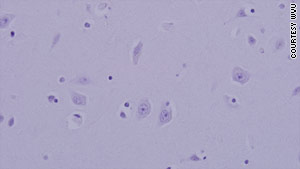
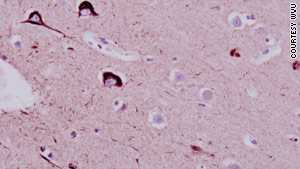
Chris Henry's brain sample had brown discolorations, a tau protein  buildup, inflammation and white matter changes.
Chris Henry's brain sample had brown discolorations, a tau protein buildup, inflammation and white matter changes.
In healthy brain tissue, virtually no protein tangles, which show  up as brown spots, are visible.
In healthy brain tissue, virtually no protein tangles, which show up as brown spots, are visible.

CTE is also known as dementia pugilistica, because career boxers who've suffered repeated blows to the head have been known to develop the syndrome. Sudden stops and collisions can cause the brain to slosh inside the skull.

Its effects are mainly neurobehavioral. These symptoms include poor decision-making, behavioral problems, failure at personal and business relationships, use of drugs and alcohol, depression and suicide.

"The effect on the brain appears to be damages to the emotional circuitry of the brain," said Dr. Julian Bailes, chairman of neurosurgery at West Virginia University.

"We think Chris exhibited some of the characteristics of the neurobehavioral syndrome of CTE," he said at a news conference Monday. "We don't know if there is a cause and effect."

The neurologists at the Brain Injury Research Institute at West Virginia University did not draw any association between Henry's actions and the disease.

"His case highlights the fact there is documented damage in someone young and actively playing," said Bailes, a former doctor for the Pittsburgh Steelers.

Bengals coach: Henry 'beacon of hope' before death

The syndrome is believed to be caused by large accumulations of tau proteins in the brain that kill cells in the regions responsible for mood, emotion and executive functioning. Tau proteins are also found in the brains of patients with Alzheimer's disease and dementia.

The findings regarding Henry's brain raised unsettling questions: Could CTE contribute to misbehavior of football players? If Henry, a seemingly healthy athlete in his mid-20s, had signs of CTE, could other young athletes have this syndrome, too?

Dr. Jon Weingart, professor of neurological surgery and oncology at Johns Hopkins University, said extrapolating from one case, like Henry's, would be a "big leap."

"That would be misleading," he said. "There's not enough data. ... To think that this is something brewing in many players -- there's no data to support that statement."

Weingart said the relationship between multiple traumas and head hits and CTE is not a proven cause and effect. At this point, it's a correlation.

Sports Illustrated: Concussions and football: Is the game too dangerous for our kids?

In 2009, the Center for the Study of Traumatic Encephalopathy at the Boston University School of Medicine reported that an 18-year-old multisport athlete who suffered multiple concussions also had CTE, a finding that a neuropathologist described as "shocking."

MRIs and CAT scans are unable to detect CTE. Detecting the syndrome requires brain samples, which cannot be given until a person is dead.

The samples are colored with special microscopic stains. In Henry's brain, doctors found a tau protein accumulation, inflammatory changes and white matter changes that were significantly abnormal.

The fibers in the brain had brown discoloration and showed significant damage.

In previous findings of former NFL players, the brown tangles flecked throughout the brain tissue resembled what might be found in the brain of an 80-year-old with dementia.

Dead athletes' brains show damage from concussions

Henry could've had a genetic predisposition for the type of brain injury, because a majority of the brains with CTE contained the gene called the apolipoprotein E3 allele.

"We may be seeing a genetic trend that Chris is in the 70 percent of those diagnosed with CTE, who have a special genetic sign," said Bailes, the West Virginia University neurosurgery chairman. "Perhaps that may be a clue as to who's at risk for this to develop."

Genetic factors could make some people less able to tolerate subtle trauma to their brains. For example, some high school athletes get a concussion and struggle afterward, while others who experience the same degree of head bump recover without a hitch.

"There's some variability of how someone is able to handle and recover from trauma to the brain," Weingart said.

Henry's case has "sparked a lot of social debate and reflection and was scientifically valuable," Bailes said.

"We want to continue to study. We don't have all the answers. We're also looking, as soon as we can, to find treatment and prevention," he said.

NFL medical heads and Goodell convene on brain injuries

The NFL has recently pledged to step up its efforts on head injuries and named new co-chairs and members to its medical committee. The league has also changed guidelines prohibiting a player suffering a concussion to practice or play.


Blog Archive